Most people have passed Northpark Gardens without realizing it is there.
The entrance sits along Northwest Highway, in one of the busiest and most familiar parts of Dallas. NorthPark Center is minutes away. University Park begins almost immediately to the south. Preston Center, Southern Methodist University, Central Expressway, and the Dallas North Tollway are all remarkably close.
From the road, however, very little of the community reveals itself.
That is precisely what makes entering it so surprising.
Beyond the entrance is a quiet collection of low rise brick townhomes arranged around mature trees, landscaped courtyards, and pedestrian walkways. The residences turn inward, away from the traffic and activity surrounding them. The sound changes. The pace changes. What first appeared to be another address along Northwest Highway begins to feel like a small residential enclave hidden in the middle of the city.
Northpark Gardens was built in 1964.

That also happens to be the year I was built, although the townhomes appear to have benefited from considerably more thoughtful maintenance.
Dallas Was Changing
It is difficult to imagine this part of Dallas as open farmland, but that history is not especially distant.
The surrounding area was once part of the enormous agricultural holdings associated with the Caruth family, one of the pioneering families that profoundly influenced the development of North Dallas.
William and Walter Caruth arrived in North Texas in 1848. They opened a general store and began acquiring the rich black prairie north of what was then the small settlement of Dallas. Over several generations, the family accumulated thousands of acres used for cotton, cattle, and dairy operations.
As Dallas expanded northward, pieces of the Caruth estate became neighborhoods, schools, commercial districts, and some of the city’s most recognizable institutions. Caruth land played an important role in bringing Southern Methodist University to Dallas. The family name remains attached to streets, parks, neighborhoods, and the historic Caruth homeplace.
The Caruth Pioneer Cemetery remains along Northwest Highway today, almost directly across from Northpark Gardens. It is an unusually tangible reminder that this highly developed urban corridor was once part of an agricultural landscape extending across much of North Dallas.
By the beginning of the 1960s, that landscape was preparing for a remarkable transformation.
A New Idea About Urban Living
Northpark Gardens emerged during a period when architects and planners were reconsidering how people might live together in growing cities.
The garden apartment and courtyard community movements placed greater emphasis on landscaping, pedestrian space, natural light, and the relationship between individual homes and shared outdoor areas.
Instead of allowing streets and parking lots to dominate the experience, buildings were frequently arranged around interior gardens and walkways. Residences faced one another across landscaped spaces. Mature trees became part of the architecture. The automobile remained necessary, but it did not have to become the emotional center of the community.
Northpark Gardens reflects that philosophy.
Its two story brick buildings are arranged around inward facing courtyards. Private entrances, patios, covered passages, low building heights, and abundant trees create a more intimate environment than one might expect from such a central location.
The architecture is not loud. It does not need to be.
Its value lies in proportion, repetition, shade, enclosure, and the quiet transition from public street to private garden.
More than sixty years later, those qualities feel increasingly difficult to reproduce.
Land in this part of Dallas has become too valuable. New construction often rises taller, builds more densely, and leaves less room for mature trees and generous common space. Northpark Gardens belongs to a moment when this land was already important, but still available for a residential community designed around landscape rather than maximum density.
Then Came NorthPark
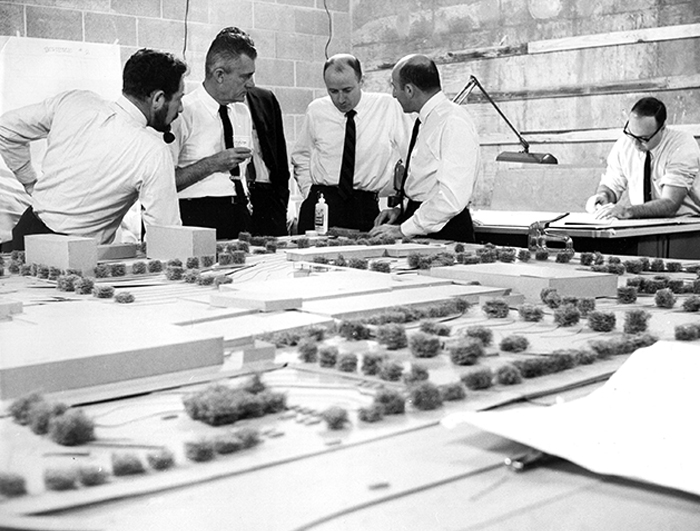
One year after Northpark Gardens was built, NorthPark Center opened in August 1965.
Raymond and Patsy Nasher had imagined something far more ambitious than a conventional shopping center. They wanted architecture, landscape, commerce, and art to exist as a unified experience.
The project rose from a large cotton field associated with the Caruth estate and owned by the Hillcrest Foundation. After efforts to purchase the property were unsuccessful, the Nashers negotiated a long ground lease and moved forward with what was, at the time, an extraordinarily bold undertaking.
NorthPark opened with clean modern architecture, carefully planned landscaping, fountains, broad interior promenades, and an emerging collection of significant art.
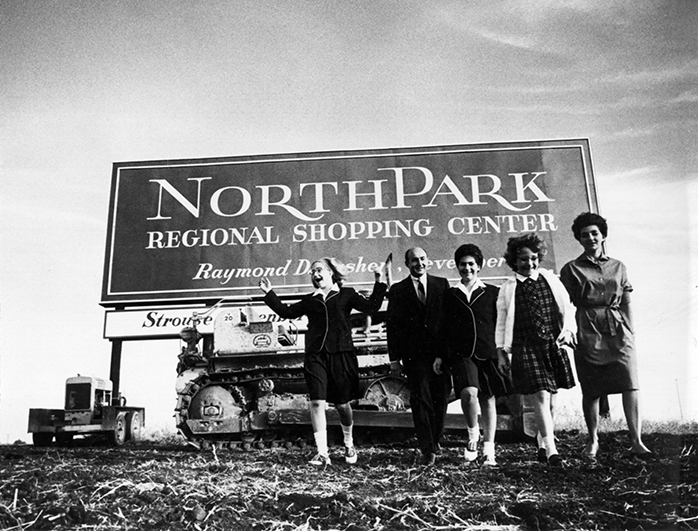
Historical photographs show an almost startling amount of undeveloped land surrounding the original center. The familiar urban fabric of contemporary North Dallas had not yet arrived. Northwest Highway and Central Expressway were carrying the city toward a new era, but much of the surrounding landscape still revealed its agricultural past.
Northpark Gardens and NorthPark Center were created within that same period of transformation.
They were different projects serving different purposes, and there is no evidence that they shared a developer or architect. Their relationship is geographic, historical, and philosophical.
Both placed unusual importance on architecture and landscape. Both were designed as inward experiences that separated visitors or residents from the traffic beyond them. Both emerged as Dallas was moving decisively northward.
Northpark Gardens was completed just before that transformation accelerated.
Hidden in Plain Sight
The community’s location is one of its greatest strengths, but location alone does not explain its appeal.
There are many properties near NorthPark Center. There are many properties close to University Park. There are many places offering convenient access to restaurants, shopping, employment, schools, and major roads.
Far fewer combine that access with mature trees, interior courtyards, private entrances, low rise architecture, and a sense of separation from the surrounding city.
Northpark Gardens offers a kind of privacy created through design rather than distance.

Residents do not have to move to the edge of Dallas to find quiet. They do not have to surrender central access to obtain greenery. They do not have to choose between the convenience of condominium ownership and the feeling of arriving at an individual home.
The community’s relative scarcity also matters. With only a limited collection of residences, available properties appear infrequently. Many owners remain for years, drawn by the combination of location, privacy, manageable scale, and simplified ownership.
The most common residences fall into two general floor plans, including homes of approximately 1,226 square feet and larger residences of approximately 1,522 square feet. Private patios, covered parking, a community pool, and comprehensive association services contribute to the community’s lock and leave appeal.
Precise association dues, included services, school assignments, and current availability should always be confirmed through current records. Those details change. The underlying qualities of the community do not.
The Value of Something That Cannot Be Recreated
New homes can offer modern systems, fashionable finishes, and the conveniences buyers expect today.
What they cannot manufacture quickly is sixty years of tree growth.
They cannot easily reproduce a small courtyard community on several acres near University Park. They cannot recreate the particular proportions of a development conceived before contemporary land prices demanded greater density. They cannot manufacture the feeling of turning away from Northwest Highway and unexpectedly entering a quieter world.
That is the enduring value of Northpark Gardens.
The community was built at a pivotal moment in Dallas history, when ranchland and cotton fields were giving way to modern architecture, new neighborhoods, and an entirely different vision of North Dallas.
Today, it remains almost defiantly understated.
Thousands of people pass it.
Relatively few know what is behind the entrance.
And for the people who discover it, that may be exactly the point.