The dishes need attention. Your inner monologue does not need a megaphone. A gentler, more practical way to get a lived-in home back to comfortable.
There is something especially rude about a laundry basket that appears to refill itself. You finish a load, turn around, and there it is again, auditioning for a permanent place in the family.
Keeping a home involves repetition, which is not quite the same thing as failure. Yet it is remarkably easy to look at a crowded counter and hear a much larger accusation.
Caroline Lubinsky’s October 20 Martha Stewart feature explores cleaning affirmations with input from counseling and cleaning professionals. Its central invitation is to replace self-criticism with a more manageable approach. We like that idea. Here is our practical take, without requiring you to deliver an inspirational speech to the dishwasher.
Choose One Small Win
Try telling yourself: “This one surface is enough for now.”
Forget the sweeping declaration that you are going to get the whole house together. Choose something with edges: the breakfast table, the sink or the chair currently serving as a wardrobe.
For example, clear a place to set down tomorrow’s coffee. Put the mail in one tray rather than migrating it from counter to counter. Return the cups to the kitchen. These are small improvements you can actually see, not a vague assignment with no finish line.
If a short timer helps, use one as a boundary, not a competition. The point is to make starting easier, not to discover how many chores you can cram into your last ounce of energy.
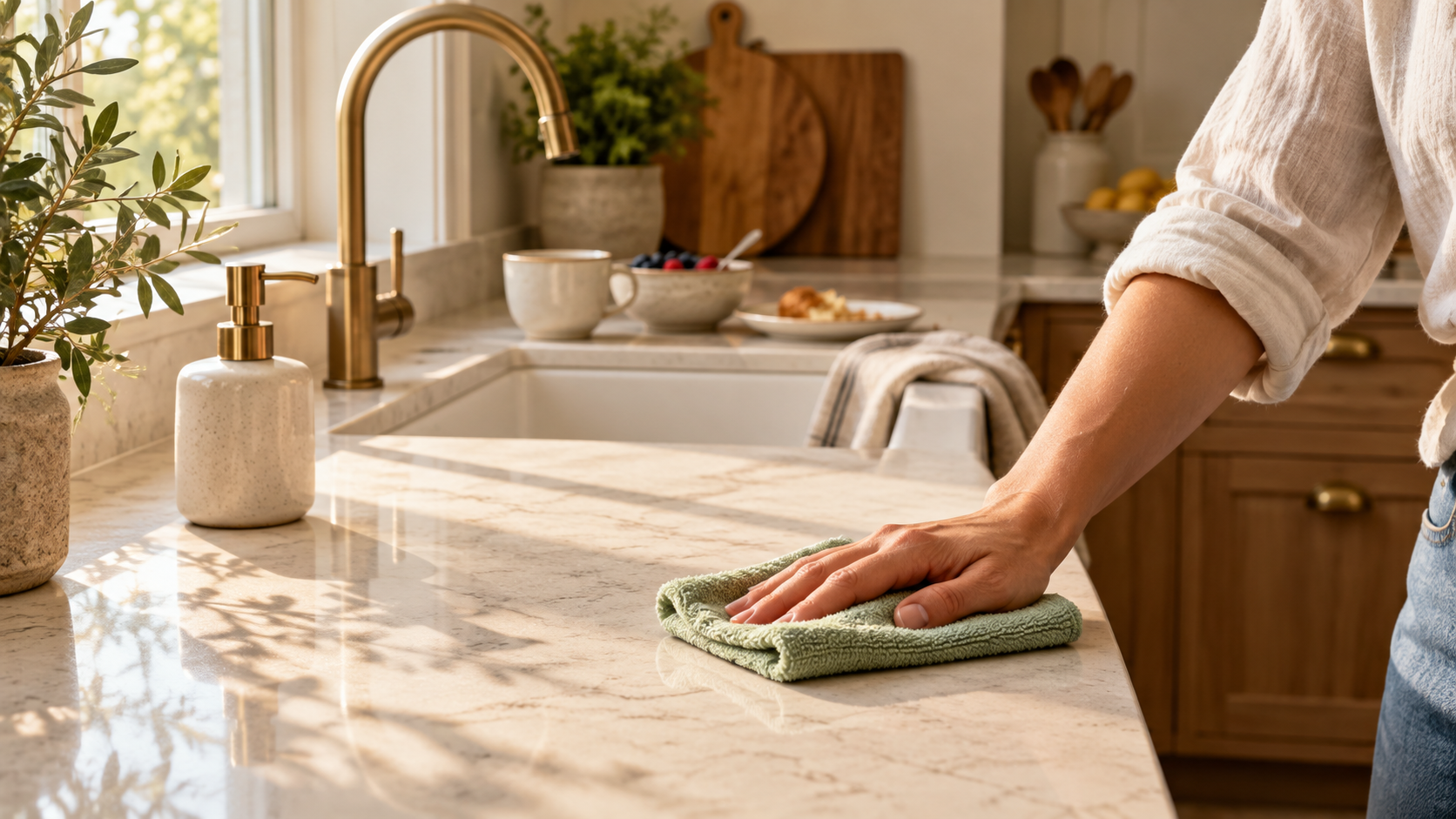
Aim for Livable, Not Untouched
Try telling yourself: “I want a home that works, not a room nobody uses.”
A sofa with a book on it is not a scandal. A throw that has been used as a throw is doing exactly what it was hired to do. We spend plenty of time admiring beautiful interiors, but the real test is whether you can comfortably live in yours.
Pick the things that make your own day run more smoothly. Perhaps that is a usable kitchen worktop, somewhere to sit and a clear route through the room. Those priorities will not look identical in every household.
This is not an argument for ignoring hygiene, spills or trip hazards. It is permission to distinguish an urgent task from a cushion that has declined to sit at a perfect angle.

Give the Chore a Place to End
Try telling yourself: “I can finish this task without adopting three more.”
The danger of putting away a towel is that you may discover a drawer that needs sorting, which leads to a closet that needs editing, which somehow becomes a proposal to reorganize your entire existence.
Keep a small later list. Write down the drawer, close it and return to the towel. If another person shares the home, make the request specific: empty the dishwasher, rather than help more. Clear tasks are easier to understand than a running commentary on everything that remains.
Give yourself a stopping point before you begin. A finished task does not have to become the opening scene of an all-day production.
Rest Is Not a Reward for Perfection
Try telling yourself: “The house can need something, and I can still sit down.”
There will almost always be another domestic project available. Homes are generous that way.
Put away what needs immediate attention, then let an ordinary pause be ordinary. Make the tea. Read a few pages. Enjoy the chair you have just cleared instead of treating it as a staging area for the next pile.
A good home should support the life happening inside it. Care for it, certainly. But speak to the person doing the caring with at least as much consideration as you give the upholstery.